Flip-Flops vs. Supportive Sandals: What Your Podiatrist Wants You to Know
When warm weather arrives, convenience usually dictates our footwear choices. Slip-on foam flip-flops remain a warm-weather staple because they are cheap, waterproof, and effortless to kick off at the pool or beach.
However, that thin strip of rubber comes with a biomechanical cost. Every summer, podiatry clinics see a predictable surge in heel pain, tendonitis, and stress fractures—injuries driven by unsupportive footwear.
Understanding the structural differences between basic flat flip-flops and medically sound, supportive sandals helps prevent chronic lower-limb issues while keeping your feet comfortable throughout the season.
The Biomechanics of the Traditional Flip-Flop
The standard flip-flop consists of two components: a flat sheet of ethyl vinyl acetate (EVA) foam and a rubber Y-strap. While sufficient for protecting skin from hot pavement or communal locker room floors, the design fails to support natural foot mechanics.
1. The “Toe-Grip” Reflex and Digital Clenching
Because standard flip-flops lack ankle or midfoot security, the foot must actively hold the shoe in place during the swing phase of walking. To keep the shoe from sliding off, the toes perform digital clenching—repeatedly curling downward with every step.
This continuous contraction places abnormal strain on the flexor tendons of the toes, significantly increasing the risk of:
- Flexor Tendonitis: Inflammation of the tendons along the bottom and sides of the toes.
- Hammertoes: Permanent muscle-tendon imbalances that cause the smaller toes to curl downward at the middle joint.
- Shin Splints: Muscle fatigue along the anterior tibialis from compensating for an unstable base.
2. Collapsing Arches and Overpronation
The human foot features three structural arches—medial longitudinal, lateral longitudinal, and transverse—that work together to absorb shock and distribute body weight. Flat flip-flops provide zero structural scaffolding underneath these arches.
When body weight descends onto an unsupported foot, the medial arch collapses, causing excessive inward rolling (overpronation). Overpronation twists the tibia (shin bone), rotates the knee inward, and tilts the pelvis forward, often triggering knee, hip, and lower back discomfort.
3. Lack of Heel Cushioning and Plantar Fascia Strain
The heel bone (calcaneus) is the first point of contact during the gait cycle. Standard flip-flops offer little impact attenuation. The force of each heel strike travels directly up the kinetic chain, while the thick band of tissue spanning the sole—the plantar fascia—is repeatedly overstretched. Over time, micro-tears develop where the fascia anchors to the heel, resulting in plantar fasciitis.
Anatomy of a Supportive Sandal: What Podiatrists Look For
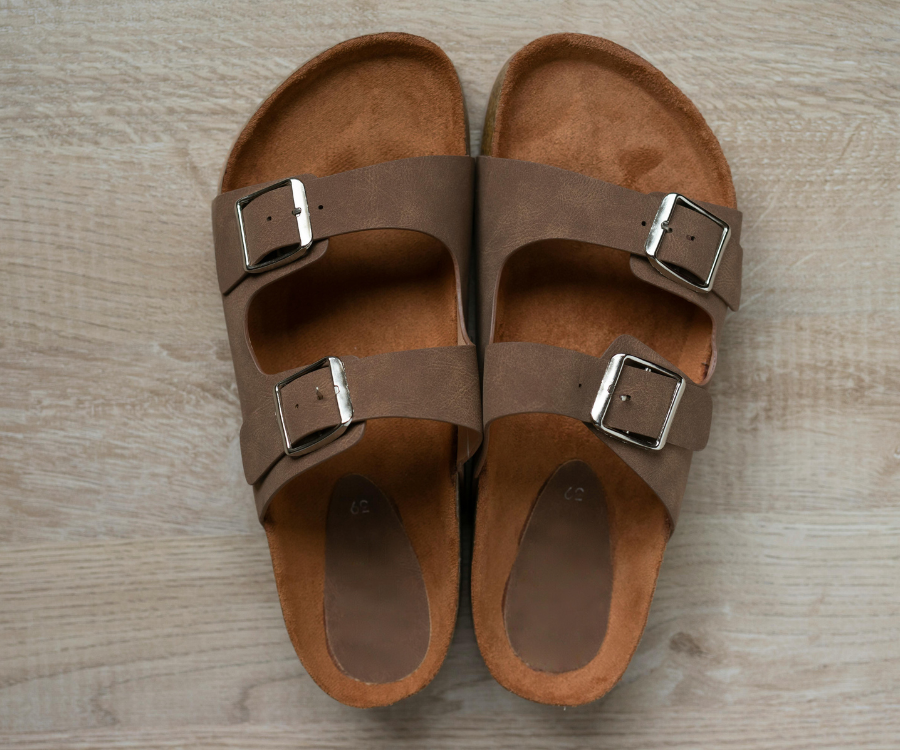
Supportive sandals (often called recovery or orthotic sandals) are engineered to mirror the natural anatomy of the foot. Unlike flat foam slabs, they act as an active interface between your foot and hard ground.
Podiatrists evaluate supportive sandals across four essential criteria:
| Feature | Flat Flip-Flop | Supportive / Orthotic Sandal | Podiatric Function |
| Arch Support | Flat; zero contouring | Anatomically contoured medial & metatarsal arch | Prevents arch collapse and mitigates overpronation |
| Heel Seat | Flat; zero stabilization | Deep, sculpted heel cup | Anchors the calcaneus and aligns the ankle joint |
| Sole Rigidity | Folds completely in half | Rigid midfoot with slight toe rocker | Shields the plantar fascia and reduces metatarsal load |
| Upper Securing | Loose Y-thong | Wide midfoot or adjustable ankle straps | Eliminates toe-clawing; secures shoe during swing phase |
The Footwear “Bend Test”
Before buying any summer shoe, conduct this simple 10-second physical evaluation in-store or at home:
- The Midfoot Twist: Hold the heel in one hand and the toe box in the other. Attempt to wring the sandal out like a wet towel. A supportive shoe will resist torsional twisting through the arch.
- The Flex Point Check: Push the toe box upward toward the heel. The shoe should bend exclusively at the ball of the foot (where your metatarsophalangeal joints naturally articulate). If the shoe folds directly in half at the arch, it lacks internal shank support and will fatigue your plantar fascia.
- The Heel Squeeze: Pinch the sides of the heel cup. A firm heel counter or sculpted cup keeps your natural fat pad consolidated beneath the calcaneus, maximizing your body’s built-in shock absorption.
Common Foot Conditions Linked to Flat Flip-Flops
Prolonged use of flat, unsupportive sandals often exacerbates or directly triggers several orthopedic conditions:
Plantar Fasciitis
Characterized by sharp, stabbing pain near the heel upon taking the first steps in the morning. Lacking arch reinforcement, the plantar fascia bears the full tensile strain of body weight during toe-off, leading to persistent microtrauma and chronic inflammation.
Achilles Tendinopathy
Because flat flip-flops have zero heel drop (the height difference between the heel and forefoot), the Achilles tendon sits at maximum stretch with every stride. Combined with unstable gait dynamics, this causes micro-tears and burning pain along the back of the ankle.
Metatarsalgia & Morton’s Neuroma
Thin soles do not disperse ground reaction forces away from the metatarsal heads. Excessive pressure at the ball of the foot can inflame the metatarsal joints (metatarsalgia) or irritate the interdigital nerves running between the toes, leading to the sharp, tingling numbness of a Morton’s neuroma.
Podiatrist-Approved Compromises: Finding the Middle Ground
You do not have to abandon open-toed footwear altogether. The goal is selecting the right tool for the right activity.
- Keep flip-flops for the perimeter: Reserve thin, water-resistant flip-flops strictly for locker rooms, public showers, and poolside surfaces to protect against fungal infections (like athlete’s foot) and plantar warts (verrucae).
- Upgrade to active sandals for walking: If your day involves more than 15–20 minutes of continuous standing or walking, switch to sandals with molded cork, polyurethane footbeds, or certified orthotic contours.
- Look for third-party medical validation: Brands that bear the Seal of Acceptance from professional associations (such as the American Podiatric Medical Association, or APMA) undergo independent evaluations to ensure they promote positive foot health.
Investing in structured arch profiles, firm heel seats, and secure strapping allows you to enjoy open-air comfort through the warmer months without sacrificing joint alignment and long-term foot mobility



No comment